★★☆☆☆ Starter folds · 7 steps
Spinning Top (Koma) That Actually Spins
Published · By The Origami Desk
Most paper tops wobble because their centre of gravity sits above the point. This one is folded so the heavy layers end up in the disc, and the point is a single folded tip rather than a soft corner.
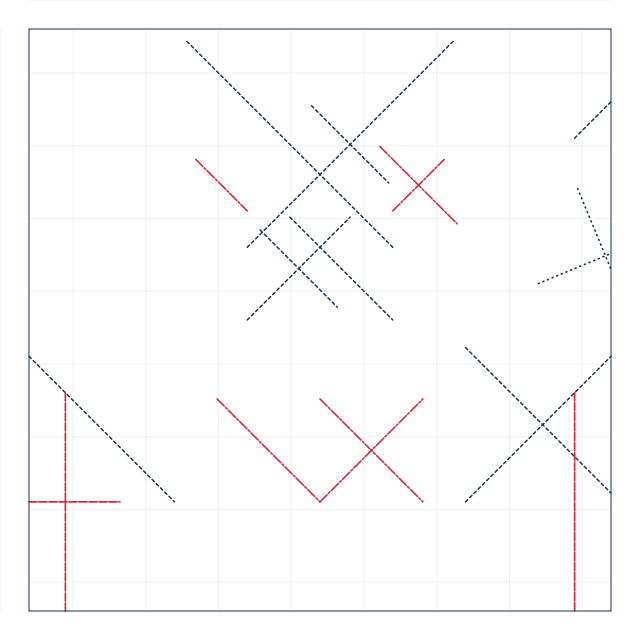
finished crease pattern
Fold sequence
1 / 7
Step 1
Square 15 cm, coloured side up. Fold both diagonals and both centre lines as valleys, then unfold everything.
Weight where it matters
The top's stability comes from step 6, where the four side flaps are tucked up into the disc. That moves four layers of paper from the stem to the rim, which lowers the centre of gravity by about 4 mm on a 15 cm top. It is a small change and it is the difference between a top that spins for two seconds and one that spins for fifteen.
Sharpening the point
The point is a single thickness of paper, and pressing it against a hard surface with a fingernail work-hardens the fibre. Press it, do not squash it: a crushed point has a flat spot and the top will walk across the table. On a good top the point is about 1.5 mm across and holds its shape for a few hundred spins.
Spin times and surfaces
On a bare wooden desk a 100 gsm top spins for 12 to 18 seconds. On paper it manages 5 seconds at best, and on a tablecloth it does not spin at all. The best surface is glass or a ceramic tile; a sheet of A4 on top of either ruins it.
Paper specification
| Sheet size | 15 cm |
|---|---|
| Sheet ratio | 1:1 |
| Paper weight | 100 gsm |
| steps | 7 |
| Difficulty | ★★☆☆☆ |
| Base | koma |
15 cm square at 100 gsm. A top made from 70 gsm paper will not spin: the point deforms under its own weight in the first second.
Crease symbol quick reference
| Crease notation used | count | first move |
|---|---|---|
| Mountain fold | 1 | Locate the line on the diagram; confirm the direction by looking at the adjacent valley folds. |
| Valley fold | 4 | Bring the edge or corner exactly to its target point and hold it there. |
| Reverse fold | 2 | Open the point along its existing crease, all the way to the base. |
| Sink fold | 1 | Identify whether the sink is open (no layers on top) or closed (layers pass over it). |
What goes wrong
It wobbles and stops
The flap tuck in step 6 was skipped, so the weight stayed in the stem. Unfold and trap all four.
The point flattens on the first spin
Paper is too thin. Use 100 gsm minimum, 120 gsm for a top that lasts.
Making it hold
- Tuck all four flaps the same way round, or the disc will be lopsided.
- Sharpen the point by pressing, not squashing.
- Spin on glass or tile; wood costs about a third of the spin time.