★★★☆☆ Core folds · 9 steps
Jumping Frog with a Spring Fold
Published · By The Origami Desk
The frog jumps because of one zigzag — a pair of mountain folds stacked under the hind legs. Flatten that zigzag and it springs back, and the frog leaves the table.
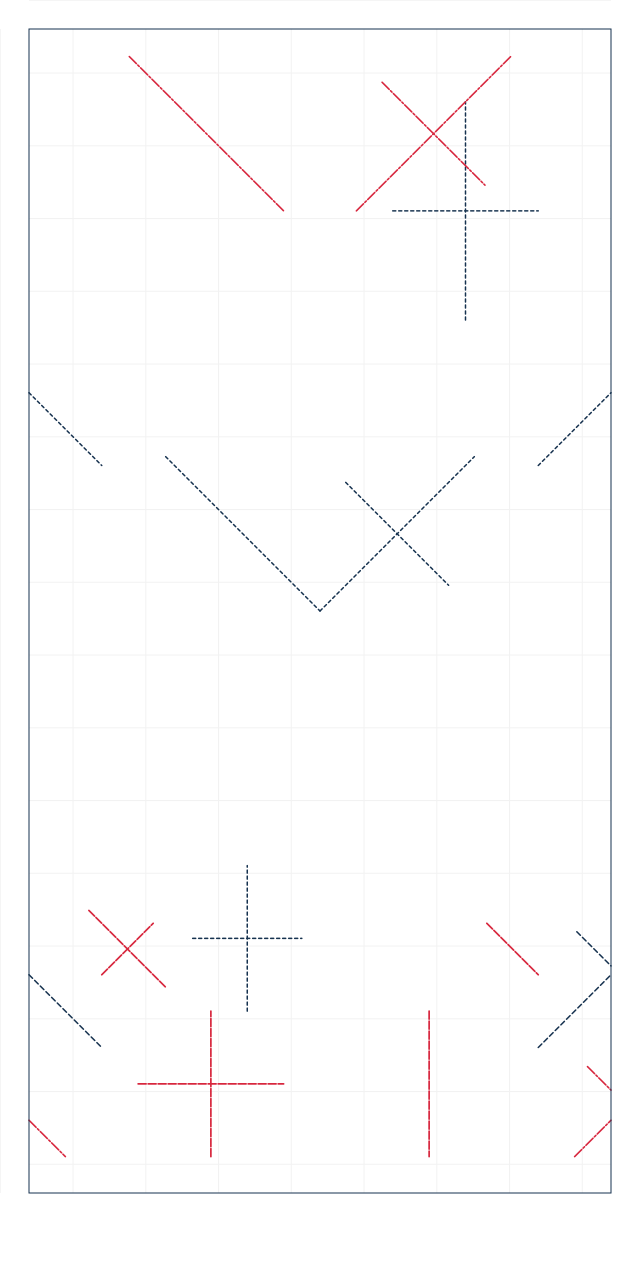
finished crease pattern
Fold sequence
1 / 9
Step 1
Cut a 15 x 7.5 cm rectangle. Place it coloured side up in portrait and fold it in half top to bottom.
The zigzag is the engine
Steps 7 and 8 create a two-pleat zigzag about 1.2 cm long under the rear of the body. Compressing it stores energy the way a leaf spring does; the frog converts that into a jump of 25 to 40 cm from a 15 cm rectangle. Fold the pleats in opposite directions and crease both hard — a soft pleat releases slowly and the frog just shuffles.
Leg angle decides distance
The hind legs should sit at about 35 degrees to the body when the frog is loaded. Flatter legs give a long, low skid that covers more ground on a smooth table; steeper legs give a higher, shorter hop. For a jumping competition on a wooden desk, 30 degrees is the reliable setting.
Competition conditions
Two things decide how far a frog goes: the surface and the paper. Glass and varnished wood give the longest jumps; paper on paper is the worst, because the front feet catch. 90 gsm paper stores noticeably more energy than 70 gsm, and frogs folded from paper that has been folded before (and so has softened creases) jump about 20 percent shorter.
Paper specification
| Sheet size | 15 cm |
|---|---|
| Sheet ratio | 1:2 |
| Paper weight | 90 gsm |
| steps | 9 |
| Difficulty | ★★★☆☆ |
| Base | frog |
A 15 x 7.5 cm rectangle at 90 gsm. A rectangle jumps further than a square because the hind legs come out longer.
Crease symbol quick reference
| Crease notation used | count | first move |
|---|---|---|
| Mountain fold | 2 | Locate the line on the diagram; confirm the direction by looking at the adjacent valley folds. |
| Valley fold | 4 | Bring the edge or corner exactly to its target point and hold it there. |
| Reverse fold | 2 | Open the point along its existing crease, all the way to the base. |
| Squash fold | 1 |
What goes wrong
It shuffles instead of jumping
Only one pleat was made, or the pleats were creased softly. Add the second pleat and press both.
It flips over
The front legs are folded too far forward. Fold them down at 30 degrees so they act as a landing brace.
Making it hold
- Crease both pleats hard; a soft spring releases too slowly to launch.
- Set the hind legs at 30 to 35 degrees for a long low jump.
- Load the frog by pressing it flat on the table, not by squeezing it in the air.